Javascript Redirect

Saturday, October 19, 2013

Church leaders: "Transgenic" plants must be used to feed poor

Many queries that lead people to this blog are from people seeking information on the Catholic position on genetically modified foods. I haven’t posted much on the issue because I didn't feel I had the right amount of information.

But now I do.

When I interviewed him for a recent interview on biodiversity, Dr. Peter Raven of the Pontifical Academy of Sciences sent me a good deal of documentation on the use of genetic sciences in the arena of food security and supply. And yesterday, Cardinal Peter K. A. Turkson of Ghana told an audience in Des Moines, Iowa that the findings of science can and should be used to feed the hungry.

As reported in the Des Moines Register,
Citing Pope John Paul II, Turkson told a room filled with about 1,000 people attending the World Food Prize symposium in downtown Des Moines that adverse climate change has affected food production in poor countries, “and the findings of science must be put to use in order to ensure a high productivity of land.”
Turkson asked why biotechnology has elicited “so much displeasure, distrust, skepticism and opposition,” when the “world rejoiced at achievements of Norman Borlaug,” the Iowa native and Nobel Peace Prize laureate who was credited with saving millions of lives with development of disease-resistant wheat varieties.
Cardinal Turkson. Photo: Flicker/Catholic Church (England and Wales)
[…]
Turkson suggested some “moral parameters” to help guide dialogue. “Some may claim that research is ethically neutral, that its application is either good or bad,” he said. “But there’s no human activity that’s ethically neutral.”
“There is a need sometimes to be prudent,” he said. “Let’s take every reasonable measure of caution beforehand to avoid the risk of human health or the environment. Such prudence is necessary to any element to advance the common good.”
And there should be transparency with the public, Turkson said. “Adopt the highest standards of communication with the public as well as rules of labeling to guarantee producers’ and consumers’ rights to information.”
“This is necessary for everyone to have a true choice,” Turkson said. “For what makes us truly human is our power to choose.”
He also called patent rights legitimate, given that research is expensive. “But it needs also to be monitored and regulated. Fair ways must be found to share the fruits of research and ensure developing countries have access to resources and innovations. “It’s crucial for humanity’s attainment of zero hunger objective,” he said.
These words echoed comments made by Dr. Raven, who himself is renowned for his studies of life on earth.

In a paper delivered to the International Symposium on Biosafety of Genetically Modified Organisms, Dr. Raven concluded that
[a]ssessments of the biosafety effects of GM crops on biodiversity should not be overly politically-driven or a burdensome impedance to delivering this technology broadly.  Biosafety scientists and policy makers need to recognize the undeniable truth that inappropriate actions resulting in indecision also have negative consequences. We should employ all the tools at our disposal in the drive to build sustainable agriculture. It is no longer acceptable to delay the use of any strategy that is safe and will help us achieve the ability to feed the world’s people. (Emphasis original)
Dr. Peter Raven
Courtesy of the Missouri Botanical Garden
Elsewhere, he has examined the impact of transgenic foods on biodiversity, a topic of professional interest to him. In writing this February to colleagues in India, Dr. Raven outlined a series of arguments to support genetically modified foods. While lengthy for a blog posting, they are helpful to read because they blend a good deal of practical and moral considerations with what science has to offer. According to Dr. Raven:
1. All crops are genetically modified. They have been the object of selection for the past 11,000 years, since crop agriculture was first developed in the Middle East and subsequently spread throughout the world. One needs only to compare a cultivated strain with its wild progenitor to know the truth of this statement.
2. For the past 200 years or so, precise scientific breeding methods have been applied to the improvement of crops. Seven more or less drastic breeding methods have been applied to re-shuffling the chromosome of individual plants and plant groups, as outlined by Gustafson, Borlaug and Raven (2010). With the exception of transgenics only, no one has ever questioned the inherent safety of any of these methods.
3. In 1974 Herbert Boyer and Stanley Cohen for the first time inserted a gene from one unrelated kind of organism into another, this precisely modifying the genetic instructions encoded in its DNA. For the past 40 years scientists have been working to determine the safety of such transgenic organisms, and they have universally determined that there is nothing intrinsically unsafe about them or the products derived from them. There is not even a theory as to why they should be unsafenone. Every academy of science in the world that has issued a statement on the safety of food produced by GM crops has agreed that there is no danger; included are the academies of India, Brazil, China, Mexico, the U.S., the U.K., and a number of other countries, each of which reached this conclusion independently after a period of study, review, and reflection.
4. Foods and medicines derived from transgenic plants have been in common and growing in use for some 20 years. These include virtually all beer, virtually all cheese, virtually all soy products, about a quarter of the medicines we use, most maize, much squash, and virtually all papayas produced. It is estimated that currently in the U.S. about 8% of the total diet consists of GM-derived components.  Not a single case of ill health has originated among those consuming such foods, and again, there is no theory about why they would become ill from consuming such foods. 
5. It is sometimes argued that transgenic plants hybridizing with the wild or weedy relatives might give rise to super-weeds or pests of some sort. With some 20,000 kinds of plants in the world classified as weeds, and no demonstrations of the predicted “super weeds,” this seems an argument of no practical value. The excessive use of herbicides or pesticides gives rises to resistant weeds whether or not transgenic plants are involved. The development of additional herbicide-resistant strains of crop plants is being pursued actively by a number of companies.
6. It is argued that the use of transgenic crops endangers the survival of traditional crop varieties and of the practices involved in cultivating them.  Such replacement is a property of any modern crop variety, and it has nothing to do with transgenic varieties per se. India’s excellent National Bureau on Plant Genetic Resources does a fine job of preserving traditional varieties in the country.  It cannot be expected that farmers should continue growing low-yielding strains of crops to preserve them unless the farmers are subsidized for doing so.  In other words, one can’t prop up sustainability on the backs of poor farmers.
Dr. Raven (who is not Catholic) isn't alone in his arguments. In May, 2009, the Pontifical Academy of Sciences issued a statement (that Dr. Raven contributed to) that supports the use of transgenic applications in agriculture. Impressively, the statement summarizes the research and thoughts of some forty scientists and it makes clear up front that researchers took as their guiding words statements of Benedict XVI in Caritas in Veritate (including that “[t]echnology, in this sense, is a response to God's command to till and to keep the land (cf. Gen 2:15) that he has entrusted to humanity, and it must serve to reinforce the covenant between human beings and the environment, a covenant that should mirror God's creative love.” Emphasis original to Caritas in Veritate.)

The document makes many points similar to those noted above by Dr. Raven. As it concludes a variety of considerations, we read that
[g]iven these scientific findings, there is a moral imperative to make the benefits of GE technology available on a larger scale to poor and vulnerable populations who want them and on terms that will enable them to raise their standards of living, improve their health and protect their environments.
And so in summary, many leaders in the Church are supporting the use of genetic engineering when used morally, rightly, and for the common good. My brothers and sisters in Christ who consider modified foods abhorrent will not be comfortable with this. And indeed, since these statements of support are related to prudential matters and are not de fide pronouncements from the Chair of St. Peter, Catholics can ignore them. But would that be wise?

As a proponent of organic gardening, farming, and eating, I find myself asking that and other questions. I, too, have much to learn and think about. And certainly, the conversation around such issues comes with many strong opinions.

The Pontifical Academy of Sciences acknowledges this debate. It also engages it. Indeed, its closing overview of issues such as the public’s understanding of science and the role of the private sector are worth the time to read and reread, as are the statement’s concluding recommendations. As did Cardinal Turkson in Des Moines, the Pontifical Academy of Sciences statement speaks to many of the concerns raised by those who object to genetic modifications within the food supply—concerns like greed, organizational corruption, scientific uncertainty, and so many other characteristics of our fallen human race.

Thus this conversation is a particular, real-world application of what we find in Section 159 of the Catechism of the Catholic Church, which teaches us about the relation between faith and reason. And as this posting has already taken more space than most, we’ll end it (but not the conversation) with those words from the Catechism—words we should read with prayerful consideration of their implications in issues like feeding the least of our brothers and sisters.
§159: Faith and science: "Though faith is above reason, there can never be any real discrepancy between faith and reason. Since the same God who reveals mysteries and infuses faith has bestowed the light of reason on the human mind, God cannot deny himself, nor can truth ever contradict truth." "Consequently, methodical research in all branches of knowledge, provided it is carried out in a truly scientific manner and does not override moral laws, can never conflict with the faith, because the things of the world and the things of faith derive from the same God. The humble and persevering investigator of the secrets of nature is being led, as it were, by the hand of God in spite of himself, for it is God, the conserver of all things, who made them what they are."

UPDATE: A reader commented on the inclusion of biotechnology in the Compendium of the Social Doctrine of the Church. This is indeed an important piece to the story. The relevant sections of the Compendium are 472 to 480 and they do indeed echo what has been noted above. Here's one example: 
473. The Christian vision of creation makes a positive judgment on the acceptability of human intervention in nature, which also includes other living beings, and at the same time makes a strong appeal for responsibility.[1002] In effect, nature is not a sacred or divine reality that man must leave alone. Rather, it is a gift offered by the Creator to the human community, entrusted to the intelligence and moral responsibility of men and women. For this reason the human person does not commit an illicit act when, out of respect for the order, beauty and usefulness of individual living beings and their function in the ecosystem, he intervenes by modifying some of their characteristics or properties. Human interventions that damage living beings or the natural environment deserve condemnation, while those that improve them are praiseworthy. The acceptability of the use of biological and biogenetic techniques is only one part of the ethical problem: as with every human behaviour, it is also necessary to evaluate accurately the real benefits as well as the possible consequences in terms of risks. In the realm of technological-scientific interventions that have forceful and widespread impact on living organisms, with the possibility of significant long-term repercussions, it is unacceptable to act lightly or irresponsibly.

Thursday, October 17, 2013

Data Series #5: What the weather can and cannot say about climate

The Data Series continues with a look at trends in weather and what they can and cannot tell us about climate.

Helping us with this is David Vallee, the Hydrologist-in-Charge of the National Weather Service’s Northeast River Forecast Center in Taunton, Massachusetts. The center provides detailed forecasting information to National Weather Service Forecast Offices and the hundreds of federal, state and local water resource entities throughout the Northeast and New York. Mr. Vallee has also served as Science and Operations Officer and Hurricane Program Leader at the NWS Weather Forecast Office. Mr. Vallee is a graduate of Lyndon State College and is known for his outreach and education work on the behavior of New England Hurricanes, including many appearances on local radio and T.V. networks, the Weather Channel, the History Channel and the Discovery Channel.

NOAA's David Vallee
Mr. Vallee has also conducted research addressing severe storms, floods, heavy rainfall production, the behavior of New England Hurricanes, and most recently looking at the changing river flood behavior as a result of the combined effects of a trending climate (warmer/wetter) and urbanization over the past 40 years.


Catholic Ecology: There has been lots of talk about this or that extreme weather event being “proof” of climate change. What should people know about the differences and the links between weather and climate?

David Vallee: We must remember that day-to-day weather is just that—changeable on a day-to-day basis. Changes in a region's climate happens over time—often on time spans of decades. No one single event should be "blamed" on climate change. However, trends in the behavior of weather systems may be based on our changing climate.
   

CE: How would a warmer climate impact everyday weather or the seasons themselves?

Vallee: Over time, we would expect to see a short winter season, increased precipitation over the long term, and a continued reduction in sub-zero temperatures and an increase in temperatures exceeding 90 degrees. Keep in mind however that this doesn't rule out having a cold/snowy winter or a cool/damp summer from time to time. These types of events however have become less frequent. The trends across much of New England clearly suggest we are in a part of the country where annual precipitation is increasing, annual temperatures are increasing and season-to-season snowfall has become extremely variable from one season to the next.


CE: It does seem like there have been more storms here in the Northeast and across the USA and the globe. What does the data say about trends in precipitation and storm intensities?

Vallee: It is difficult to say explicitly that storm intensity has changed. Likewise, it is difficult to say the frequency of any particular type of major storm event has increased. But what we are seeing is that when these major storm systems develop they seem to packing more of a punch; more moisture, slower moving, more energy etc. Our region has seen this play out in a variety of ways. The March 2010 floods [in Southeastern New England] consisted of 4 major rain events in 5 weeks, influenced by El Nino and blocking high pressure to our north over Greenland. In a warming climate these types of blocked atmospheric flow regimes are expected to become more frequent. What this means in our region is that if we get stuck in a blocked pattern that has the storm track aimed at New England, we will see lots of precipitation, be it rain or snow.  


CE: Are there other trends you’re noticing that have you concerned?

Vallee: The combination of increased annual rainfall, the up-tick in heavy precipitation events, falling upon our urbanized small to moderately sized watersheds has me most concerned. A wetter regime means our lakes, reservoirs, and soils are wetter more often. Urbanization along some of the basins as limited their capacity to effectively move the water through the system. Increase the rainfall just a bit and you increase the risk for flooding. Similarly, the sea level rise on the coast is equally concerning. We have lost 150 to 250 ft or more of coastline since the 1938 hurricane. This does two things: it places more properties at risk for flooding from hurricanes and it sets us up for a weaker storm being capable of producing inundation along the coast that we would have expected to only happen from a stronger storm. I feel that to some degree, Sandy illustrated this along the Rhode Island coastline last October.


CE: How do recent storms in our area differ from what we may have seen in the past?

Vallee: Parts of the northeast [United States] are now experiencing storms that have more moisture to work with. I don't believe we are necessarily seeing an increase number of storms (nor'easters, hurricanes, etc.). That behavior change is what may be driving the increase in annual precipitation throughout the region. Similarly, prolonged cold snaps have become less frequent and this has resulted in a shift in the spring date when ice typically lets out of the interior rivers, results in a reduced duration of snow covered ground, and during the transition between winter and spring, can result in higher river flows from runoff prior to the start of the growing season.
Aftermath of Sandy along the Rhode Island coast. 
Photo RI DOT


CE: What else would you like people to know about recent weather trends and patterns, or possible future trends?

Vallee: Given the new regime we seem to be in, the questions in mind are focused on infrastructure; are we designed for this new "place" we find ourselves in?  This applies to the vulnerable coastline as well as our inland rivers and streams. Difficult choice lay ahead when it comes to land use, design criteria, local preparedness and mitigation efforts, etc. Even if we were to plateau [at current] trends and stay about where we are today, are we positioned to deal with these type of weather events to reduce their impacts, reduce the damages and the risks posed to the infrastructure, the business community, and our citizens? Time will tell.

Friday, October 11, 2013

Opening our doors, fostering dialogue

A grainy picture of St. Francis overlooking local climate scientists
at the Diocese of Providence's St. Francis Feast gathering.
A week ago tonight my diocese observed the Feast of St. Francis with a special evening of faith and reason. (I should have posted on this sooner, but it was one of those weeks.)

Some fifty people came to hear local scientists and policy makers speak about climate change and how it has impacted—and how it will increasingly impact—Rhode Island and Rhode Islanders. It was a wonderful evening that brought together my friends and colleagues in the Church with my friends and colleagues in environmental professions. The event also allowed me to meet some fine folks that came by to listen in.

The intent of the gathering (held at St. Paul’s school auditorium in Cranston) was not to win converts to climate change or to Catholicism. Rather, the goal was simply to allow the Church to demonstrate its proper role of bringing moral arguments to worldly matters. In this case, the matter happened to be the highly polarized subject of climate change. But in doing this—by allowing the Church to provide a forum for a climate change talk—some of those who showed up for the science were also introduced, perhaps for a first time or in a new way, to the one, holy, catholic, and apostolic church.

The result was, by any account, an overwhelming success. I encourage all my Catholic brothers and sisters to do something like this for any sort of environmental issue. It’s not hard to do. And you don’t need to be a scientific expert to do it. In fact, there are many resources available to help, most especially at the Catholic Climate Covenant.

Here’s the basic recipe:
  • Choose your eco topic—preferably one of some local interest.
  • Reach out to experts, local ones particularly but national ones if you can. Chances are they are looking for community venues to share the fruits of their efforts and the findings of their profession’s science.
  • Find a parish that’s willing to host the event—preferably one that serves a community affected by the issue at hand.
  • Schedule.
  • Advertise.
  • Reach out to the media—reporters are typically intrigued when the Church offers these sorts of events.
  • Bring food.
  • Prepare a free handout or booklet on science of the topic at hand and on the Church’s teachings on ecology. (Again, there are some great resources at the Catholic Climate Covenant as well as at the website for the United States Conference of Catholic Bishops.)
  • Open with prayer and an overview of why the Church desires to help in such worldly matters; let the experts speak for most of the event; wrap up with prayer; then let the informal conversations take whatever form they will. And, of course, trust always in the presence of the Holy Spirit.
A great example of a Church-sponsored eco gathering took place in 2012 when two dioceses from Ohio sponsored a public meeting on fracking—an issue of great local concern. It was by all accounts a fantastic success in bringing various parties to the table and allowing the public to have access to the conversation.

I’ve been thinking of that event a lot lately. Now that my diocese’s gathering on climate change has come and gone, I’d like to work to up the ante by planning earlier, providing more outreach, and bringing in some nationally known names. After all, the topic of climate change is not going away and Rhode Island will experience the certain effects of rising seas, increasingly strong coastal storms, and heavier inland rains. This makes it a moral necessity to get information to the public and to foster a dialogue that maintains the dignity of the human person and the importance of the common good.

I also appreciate the effect that such events have on those who may know very little about Catholicism—about the Church that instituted universities, hospitals, orphanages, and the scientific method. Indeed, from my own experiences, those entrenched in the secular world of environmental policy—whether in government or academia—are getting worried. Human policies and efforts seem to be taking things only so far—and not far enough.

And so, perhaps, secular scientists may notice that the Church is offering an alternative to the policies of human thought. Perhaps they hear within the Church’s teaching a voice of reason guided by morality, one that transcends human opinion and exhorts virtuous behavior.

All this makes the hosting of such eco events more than a nicety that can be done if time allows. As Pope Francis has been showing and urging us, the Church must insert her voice and activity into the human condition. This includes matters of serious ecological realities—for these directly relate to the common good and they impact individual lives.

And so let us pray for and help each other make these gatherings happen. Let us invite scientists and our neighbors to our Church halls and to our cathedrals. Let us support each other in bringing the Catholic voice to eco issues (and others)—and in doing so let us introduce our neighbors directly (that is, unfiltered by the media or past perceptions) to the Church and her quite necessary truths.

I look forward to hearing from a great many of you as you consider, plan, and implement your local eco gathering(s). After all, as more of these events are held, we can, by the grace of God, help in our own small ways to renew the face of the earth. 


Saturday, September 28, 2013

The IPCC report: When climate change gets personal


On Friday as the United Nations Intergovernmental Panel on Climate Change released its most recent update on climate change, I was meeting with congressional, federal, and other state officials about coordinating for a changing world.

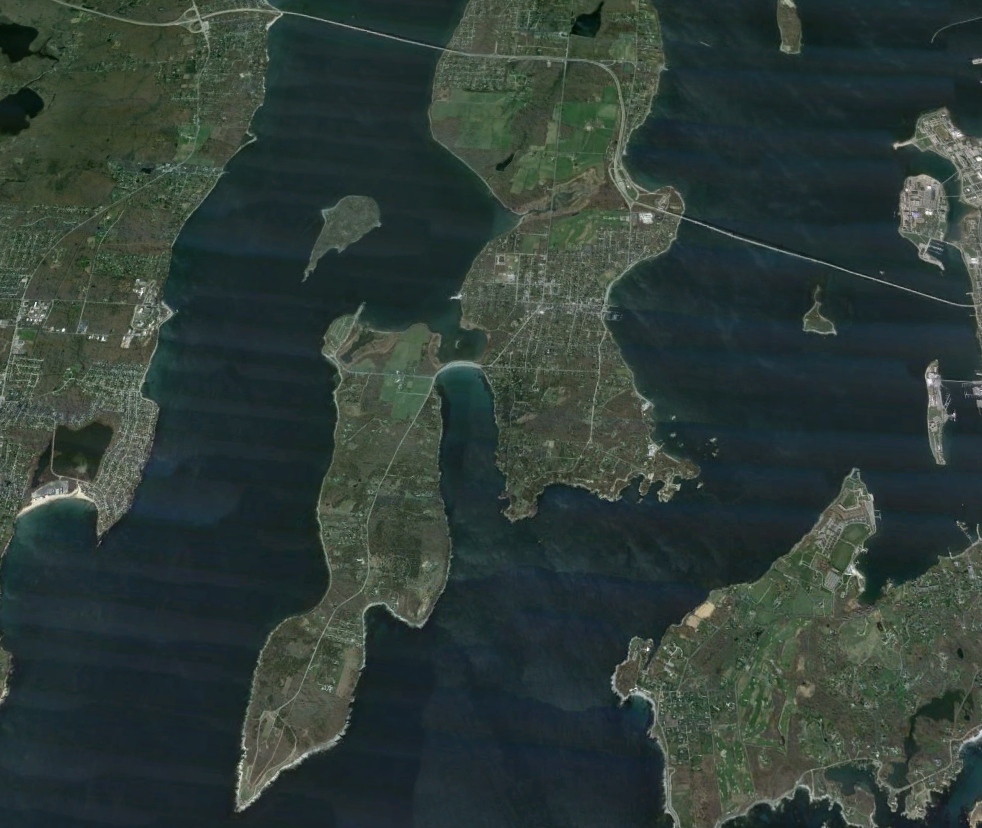
During the meeting, the head of my state’s planning office passed around a few sample inundation maps. One of them was of Jamestown, which is made up of two islands in Narragansett Bay connected by a natural and fragile causeway. 

Over the past few years I’ve seen lots of these maps. I will see many more as my office works with other agencies to determine the vulnerability to wastewater infrastructure from rising seas, increased levels of storm surge, and more intense precipitation. But this particular inundation map broke my heart. It showed the areas of Jamestown subject to rising seas and it included a solid swatch of red on the causeway that connects Jamestown’s two main islands. While the town’s largest area is accessible to the mainland by a large bridge (which isn’t going anywhere anytime soon), the town’s western “tail” is only accessible via that small sandy causeway. 

What hurt was that the map’s red swatch indicated areas threatened with submersion during increasing storm surges and, eventually, permanently because of a rise in sea level. 


Beavertail State Park is on that small island to the west. This funny sounding place is one of the planet’s most beautiful and invigorating. It certainly delights my mom, even if in her old age she can't explore its shore as she well as she did with my dad. But I still drive her there—over the causeway—so that she can stare out into the ocean and let the salty wind rush around her. 

Beavertail's rocky tip cuts into Narragansett Bay like a ship’s bow aimed into the Atlantic. A nineteenth-century lighthouse sits close to the island's edge, often flashing and sounding warnings to passing sailors. These are necessary because the glacial shore rolls steadily into offshore reefs. But those dangers are assets for people onshore. A mix of smooth and layered rock provides hundreds of viewing and fishing platforms and many more crevices and tidal pools for children of all ages to explore. All this is accompanied by the ongoing trio of gull cries,  wave upon wave on rock, and the wind from far-off waters.
The causeway during Tropical Storm Sandy. 
Photo Andy Manca

I can’t imagine how anyone at Beavertail could be an atheist. 

But as the Atlantic Ocean rises and my state’s coastal features move, erode, or disappear, Beavertail’s causeway will likely vanish, as that projection map demonstrated (and as experiences have already shown in major storm events). In time, the projections say, the only visitors to this spot will be boaters who may have to hike long distances to experience what so many generations of Rhode Islanders and so many more visitors have loved so much for so long.


Given all the news on the IPCC report, the probable isolation of Beavertail is hardly the worst issue to speak of. As I plan for the worst at work and home, there are many more pressing scenarios than a causeway that takes automobiles to Beavertail, even if the island is home to a number of private property owners. Elsewhere, entire communities are seriously threatened along Rhode Island’s 400-mile shoreline (which is a sizable number considering the state is only some 1,200 square miles) and along the East Coast.

While someone like me can become numb to these projections—even to the scenes of destruction from events like Hurricane Sandy—there are times when the truth sinks in, when climate change gets personal. For instance, in 2010 my hometown’s river made national news when it flooded the village a few blocks from me. In the midst of the turmoil I couldn’t help but think of the growing amount of meteorological tending data that predicted such events. 

In a similar way, the truth also cuts deep when I look at projections. 


Because I grew up in Rhode Island, I know many of its threatened coastal features and small villages from my childhood, when my mom and dad, brothers, and cousins would spend days at the shore. My dad died seventeen years ago but I can still see him deftly skipping stones as he patiently taught me that rock-throwing skill on the sunny waters off Jamestown. (You really do have to throw a well-shaped, flat stone at just the proper angle. And there really is a right method of holding the stone when throwing it.) I remember managing a double or triple skip, but most times my stones would hit the water hard and sink. Either way, my dad kept showing me what I needed to know, even if I wasn't always the best student.

The particular section of shoreline where this all took place in the early 1970s is just around the bend from Beavertail. In time it will be underwater even during low tides. Later it will be part of the bay’s floor as seas rise and many coastal gems become memories. 

Photo: Flicker/by sapienssolutions
Yes, features will shift and new coastal areas will appear for future generations. This process will be terribly tragic for some who will lose their homes. Others, like me, will see our favorite perches on the bay go under water. In time, future Rhode Islanders will have never known what I and so many know now. I suppose that is the way of things. 

These losses will hurt and hurt all the more when we lose what we love not because nature is taking its course but because we were too slow and too stubborn to see what we were doing—because we couldn't see what was happening and change the way we lived.


Let us hope and pray that events unfold otherwise—that those maps may be wrong
if it is not already too late to do so.


Saturday, September 14, 2013

The Holy Cross: "That the world might be saved through him"


Then he said to all, “If anyone wishes to come after me, he must deny himself and take up his cross daily and follow me. For whoever wishes to save his life will lose it, but whoever loses his life for my sake will save it." Luke 9:23-24.


A coworker came to my office yesterday excited by the news that the Church was revisiting clerical celibacy. He was, of course, profoundly misinformed by the secular media. NBCNews especially botched their reporting of comments made by the new Vatican Secretary of State, Archbishop Pietro Parolin. Reporter F. Brinley Bruton thought that the archbishop was breaking new ground, which, of course he was not. 

Putting to one side the details of this latest mainstream media misstep, the conversation with my friend and coworker allowed me to point to an image on my wall calendar—an image of the Cross. I did so because as I explained the purposes of clerical celibacy I was speaking about the Gospel of sacrifice that the world would rather do without.

And so there we were, two environmental regulators, pondering the Cross of Jesus Christ. And really, the Cross is a topic that environmentalists must be comfortable embracing.

This particular September 14th, as the Church celebrates the annual Feast of the Exaltation of the Holy Cross, we find the world worried over war in the political sphere and equally worried over humanity's sustained war against nature. As seen from the Data Series interviews so far (here, here, here, and here), man is inflicting unprecedented harm on creation and it will not be easily undone.

What Catholic ecologists seek to bring to discussions of environmental protection is the prophetic statement that the roots of our ecological crises are spiritual crises. In large part, the damage we inflict on creation stems from our individual and collective inability to control our appetites—disordered as they are, seeking fulfillment in worldly things when in fact what we truly seek is a Someone, and that someone is love itself, a divine Trinity of three persons—Father, Son, and Holy Ghost. The desire for God's love isn't difficult to understand. What is difficult is turning toward God and away from our vices.

It is notable that after the words that open this post, Luke places the event of the Transfiguration. In doing so, Luke tells us that the Cross leads to the glory foreshadowed at the Transfiguration. Or as is noted in the famed prayer attributed to St. Francis, “it is dying that we are born to eternal life.”

The necessary changes to our lifestyles that will slow and, one hopes, reverse the rampant and dangerous destruction of our planet’s ecosystems will come only by our seeking the grace of God and by the taking up of our crosses of self-denial. 

This has been foreshadowed in these old Catholic petitions: "Lord, grant me the grace to mortify my senses—to be in this world but not of the world."

And as we read in the Gospel of this feast day, 
Jesus said to Nicodemus: "No one has gone up to heaven except the one who has come down from heaven, the Son of Man. And just as Moses lifted up the serpent in the desert, so must the Son of Man be lifted up, so that everyone who believes in him may have eternal life." For God so loved the world that he gave his only Son, so that everyone who believes in him might not perish but might have eternal life. For God did not send his Son into the world to condemn the world, but that the world might be saved through him. John 3:13-17


Tuesday, September 10, 2013

Data Series #4: Climate change and human inertia

Our occasional interview series continues with a well-known name in climate change science and policy.

Dr. Michael Oppenheimer is the Albert G. Milbank Professor of Geosciences and International Affairs in the Woodrow Wilson Schoo and the Department of Geosciences at Princeton University.

He is the Director of the Program in Science, Technology and Environmental Policy (STEP) at the Woodrow Wilson School and Faculty Associate of the Atmospheric and Ocean Sciences Program, Princeton Environmental Institute, and the Princeton Institute for International and Regional Studies.

Dr. Michael Oppenheimer.
Photo: Princeton University
Dr. Oppenheimer joined the Princeton faculty after more than two decades with The Environmental Defense Fund (EDF), where he served as chief scientist and manager of the Climate and Air Program. He continues to serve as a science to EDF and is routinely sought after by the news media for his climate and policy expertise.

Dr. Oppenheimer is the author of over 100 articles published in professional journals and is co-author (with Robert H. Boyle) of Dead Heat: The Race Against The Greenhouse Effect. His full biography can be found here.


CE: You bring a range of experiences to the climate change conversation—from academia to non-government organizations to the IPCC. With this unique perspective, what do you find is usually missing in the general public’s understanding of anthropogenic climate change and its impacts?

Dr. Oppenheimer: What’s missing is not so much understanding as political leadership. Like most technical issues, the public doesn't have the time to get deeply into the factual arguments. Generally, they look to opinion leaders whom they trust: the President, some Congressional leaders, religious leaders, individuals like Al Gore to give them a sense of where the reality stands. Of course, on some issues, the details are less important than overriding concerns like ethical implications, and people are perfectly prepared to and capable of making their own judgments. On climate change, I believe the public gets the big picture, the long-term stakes, the ethical issue, but has a lot of confusion (exacerbated by intentional obfuscation by some economic interests) on the details. Clear, consistent political leadership, day in and day out, is the one irreplaceable factor for overcoming this sort of confusion.


CE: Likewise, what scientific nuances do government leaders often struggle with?

Dr. Oppenheimer: Governments on the whole understand the details. They have lots of in-house experts telling leaders the truth (when they ask). The struggle is over their willingness to pay short-term costs to preserve the climate and the planet’s sustainability for the long term.


CE: With new studies being added to what we already know about climate change in preparation of the latest IPCC report, what do you think the next six months to a year hold for policy makers and national and local governments?

Dr. Oppenheimer: It’s going to be an interesting ride. I’m an IPCC author so I can’t discuss the details until they are public but I’m confident that the report will provide further details, allowing governments to sharpen their approaches and adding another dose of seriousness to the need for international cooperation to solve the problem. At this point, governments are falling behind what the science says is needed to stabilize the climate during this century.


CE: Many of us encounter critics of climate change science. What would you say are three or four quick statements that would be helpful when dialoguing with these critics?

Dr. Oppenheimer: 
  • Carbon dioxide, the main human-made greenhouse gas survives for centuries to millennia once emitted so today's actions commit the climate to harmful changes for many, many generations.
  • Earth is already warming, and most of the warming is very likely due to carbon dioxide and other greenhouse gases.
  • The projected warming, if emissions continue to grow, would make earth warmer, and warm faster, than any time in the history of civilization.
  • Hurricanes Katrina and Sandy show just how ineffective we are currently at dealing with today’s climate risk. The risk is increasing be the year, and we will inevitably be falling further behind—that means losses of life and losses of property. We need to redouble efforts at adaptation and managing the risk but there’s no way to keep up with the changes without decreasing the emissions causing the problem.

CE: In some circles, there seems to be a growing focus on climate adaptation rather than mitigating the sources of climate change. Given what we know about the rates of greenhouse gas emissions, is mitigation a viable option in the next decade or so? Or is it more realistic to say that adequate emissions reduction will take a century or two to achieve?

Dr. Oppenheimer: We need to mitigate starting now and we need to improve our ability to adapt, starting now as well. Mitigation isn't going to avert all impacts and adaptation can’t possibly sufficiently ameliorate the changes headed our way if we fail to cut emissions.


CE: Is there a question that interviewers never ask you but that you wish they would? 

Dr. Oppenheimer:  After all these years (32) working on climate, I've been asked it all!


Saturday, September 7, 2013

A homily for peace—and creation

“And God saw that it was good” (Gen 1:12, 18, 21, 25). The biblical account of the beginning of the history of the world and of humanity speaks to us of a God who looks at creation, in a sense contemplating it, and declares: “It is good”.  This allows us to enter into God’s heart and, precisely from within him, to receive his message.  We can ask ourselves: what does this message mean? What does it say to me, to you, to all of us?
The homily given by Pope Francis at today’s peace vigil included some profound catechesis. It also occasionally sounded like a homily for Earth Day. This should come as no surprise since many of the roots of man’s violence against nature are the same as those that sound the drums of war.

Benedict XVI said that it is a disorder of our “inner attitudes” that corrupt our good human nature. This disorder makes us selfish, demanding, and gluttonous consumers of worldly pleasures.

Today, Pope Francis put it this way: 
When man thinks only of himself, of his own interests and places himself in the centre, when he permits himself to be captivated by the idols of dominion and power, when he puts himself in God’s place, then all relationships are broken and everything is ruined; then the door opens to violence, indifference, and conflict. This is precisely what the passage in the Book of Genesis seeks to teach us in the story of the Fall: man enters into conflict with himself, he realizes that he is naked and he hides himself because he is afraid (cf. Gen 3: 10), he is afraid of God’s glance; he accuses the woman, she who is flesh of his flesh (cf. v. 12); he breaks harmony with creation, he begins to raise his hand against his brother to kill him.  
And so in the midst of worldwide conflicts, Christianity offers a view of creation—and thus of mankind—that denounces the belief that man’s foundation is corrupt. It proclaims that our foundation is God—the Creator of heaven and earth, of all that is visible and invisible. And God, who is love and relationship, is indeed the perfection of good.

Here I would like to restate a reply in my recent interview with Dr. Robert Brinkmann of Hofstra University. My answer helps place into context how the Christian understanding of creation—and thus reality—shapes our hopes and expectations—and can then inform our actions. Dr. Brinkmann had asked me about the roots of the Christian understanding of ecology. I answered that 
[i]t goes back to the beginning—to those early mystics within the nascent people of Israel who recorded (orally at first and then in writing) that in the beginning God created everything good and orderly. Hebrew Scriptures are a love story about God’s relationship with humanity and the entire cosmos. It’s a revelation about the innate goodness of all creation. What we often don’t appreciate is how this message was a radical addition to human thought made by the early Jewish people. All around them—in ancient Babylon and Assyria—much more powerful nations taught that evil existed before the creation of the world. The Jewish people, inspired by God within human history, said no to this. Interestingly, this teaching on the goodness of creation that we find in Genesis (which we all know is not a science book) survived and remains with us today while the Babylonian creation stories (which presupposed evil) were lost for centuries in the sands of the Middle East.
 This insistence that creation is good because God created it is a central reality within Christianity. Christians proclaim that the Word of God entered the human condition in Jesus Christ. That alone elevates the natural world. And then, as taught by Christ, the natural world becomes a vehicle of coming into contact with God’s grace—for instance, through baptism with the use of water; Communion through the sacrificial offering of bread and wine; reconciliation, with the familiar use of human dialogue; healing, with primitive oils. And then there is Mary. She also connects creation with the divine in an amazing demonstration of love and relation.
 At today’s peace vigil, Pope Francis put it this way: 
All of creation forms a harmonious and good unity, but above all humanity, made in the image and likeness of God, is one family, in which relationships are marked by a true fraternity not only in words: the other person is a brother or sister to love, and our relationship with God, who is love, fidelity and goodness, mirrors every human relationship and brings harmony to the whole of creation.  God’s world is a world where everyone feels responsible for the other, for the good of the other.  
But then he added:
This evening, in reflection, fasting and prayer, each of us deep down should ask ourselves: Is this really the world that I desire?  Is this really the world that we all carry in our hearts?  Is the world that we want really a world of harmony and peace, in ourselves, in our relations with others, in families, in cities, in and between nations?  And does not true freedom mean choosing ways in this world that lead to the good of all and are guided by love?
Good questions. And they are appropriate not just in times of war. We must ask the questions during every moment of our lives. For how we answer them—how we choose to live our lives—determines not just the fate of nations or the prospects of conflict. Our answers also dictate whether we will tend to or devastate the garden that is Earth.


Wednesday, September 4, 2013

Five eco-reasons why we don't want war

While the American political machine considers whether or not to stoke the fires of Syria, more reasoned voices are calling for peace. Pope Francis is one such voice and he has added prayer and fasting to this call. 

While we wait, pray, and fast for miracles (small and big ones)—and as we call in all sincerity for truce and dialogue—the horrors continue. And so we think of the immediate harm done to people remaining in Syria and to the over two million who have fled. We think of the violence done to individuals, most often the weak and innocent; to families; and to entire communities. Compounding the suffering of war is the damage to natural environments. This is not a small issue because such damage impacts people during and long after the fighting ends.

Here are five reasons why eco-issues count when we go to war:

War pollutes water supplies: Drinking water comes from reservoirs, rivers, or groundwater. The bombardment of weaponry contaminates these supplies with a missile's residue and with the debris of what was once a built environment. Fuel contamination, metals, spilled chemicals and chemical weaponry can easily turn a region’s water supplies into a toxic slurry. For the most vulnerable people—children and the elderly—such contamination results in imminent harm if this water is ingested or slow dehydration when family members are forced to travel long distances to find clear, potable water. Basic sanitation also quickly becomes an issue when clean water is not readily available.

War pollutes the air: Soldiers, well-connected rebels, and well-prepared civilians may have gas masks during times of war. For those without such devices, toxins and particulates can be a regular component of what one takes into one’s lungs. Smoldering fires and regular bombings can keep the air sullied for hours and days—or weeks or months.

War obliterates natural habitats: All that teeming life that God found good in the Book of Genesis needs a home. In fact, most life forms prefer particular kinds of homes. The destruction brought by war—along with all that polluted water and air—devastates a region’s unique natural habitats, and unique habitats help define a quality of life. Besides the damage to non-human species, habitat destruction can easily impact local fishing and agriculture, which only adds to the suffering of the innocent.


Photo: Flicker/ninjawil
War destroys infrastructure:
Roads, bridges, and airports become the frequent targets of bombing. Other targets—whether intended or not—include underground water and sewer lines, drinking water and wastewater treatment facilities, and other infrastructure necessary for public health and a clean environment. Such infrastructure is expensive to replace and not quick to rebuild. This damage becomes a long-lasting communal wound long after conflicts cease. And thus the suffering continues as people lose access to clean water and as their natural waterways are contaminated with sewage.

War leaves behind a toxic dump: Added together, the consequences noted above are compounded by the debris of factories, homes, vehicles, above- and below-ground chemical storage systems, electrical transformers, and a host of other man-made systems and devices that use toxic chemicals, heavy metals, fossil fuels, and lost more. Then there is the matter of regular garbage pickup, which can easily come to a halt during times of war. With massive amounts of debris strewn about during and after a war, cleanup takes time—lots and lots of time. And even after debris is hauled away—hopefully to a safe landfill—widespread soil contamination often makes once pristine neighborhoods uninhabitable.

This is of course a short list. It is neither detailed nor specific to a particular conflict. But this subject does not require advanced degrees to understand. 

Under specific circumstances, some wars can be justly waged. But William Tecumseh Sherman said it best in the late nineteenth century: "war is all hell." One reason why this is so is because war leaves behind a hellish environment when it’s over, scarring for a long, long time God’s very good, life-sustaining creation.